
Bedside Harp's Harp Therapy
Certification Programs for Adults:
Comprehensive, Mindfulness-Based
Studies
PLEASE NOTE: We strongly encourage our Certification Students, Interns and Graduates to be fully COVID Vaccinated.*
Harpists who wish to pursue a career in healthcare are invited to begin their professional training with us. Our Certified Harp Therapist (CHT) and our Certified Master of Harp Therapy (CMHT) offerings, which ran from 2002-2016 as college-based programs, and since 2017 have been accredited by the National Standards Board of Therapeutic Musicians (NSBTM) are now presented 100% online in real time. They are designed to train adult harpists and harpers to work as healthcare professionals in a variety of medical and wellness settings including acute care and behavioral health hospitals, hospices, long-term care facilities, assisted living, memory care, cancer centers, dialysis centers as well as doctors’ and dentists’ offices.
*As a training program teaching harpists to become healthcare professionals serving vulnerable populations, Bedside Harp strongly encourages our students, interns and graduates to be COVID vaccinated and to have had at least one booster, in accordance with the current protocols of the hospitals that host us.
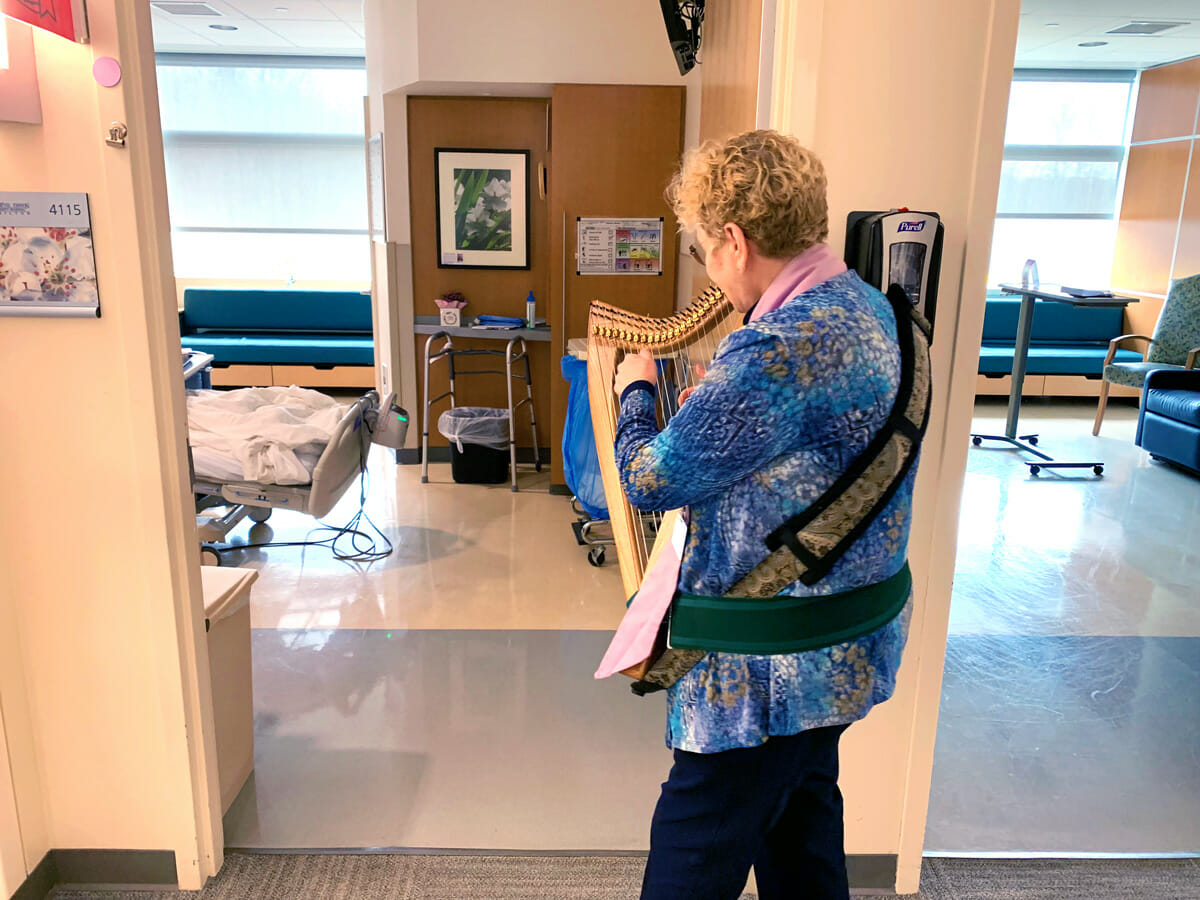
Our mindfulness-based, team-taught CHT level iconsists of 85 classroom hours divided into four modules, 12 additional hours of music and repertoire development, a 130-hour closely mentored internship, 13 one-on-one contact hours with a mastery level certified harp therapist, and a 12-week, 36-hour online course, “Conversations on Ethics for Therapeutic Musicians.” Additional requirements include repertoire and improvisation development, completion of a practicum project, as well as assigned readings, viewings and writings.
To achieve the level of Certified Master Harp Therapist (CMHT) one must have met all of the requirements for the CHT and have taken an additional 200 hours of studies consisting of a 120-hour mastery level supervised internship, 12 one-on-one contact hours, our 12- week, 48-hour online advanced level course, “Conversations on Research for Harp Therapists,” and Module IX, online (in real time) 20-hour workshop/retreat on “Harp Therapy as a MindBody Modality.” Additional requirements include repertoire and improvisation development, assigned readings and writings, as well as a final practicum project presented both in writing and orally.
Graduates of other NSBTM- accredited programs are welcome to register for our Bedside Harp mastery level of certification after their successful completion of required pre-requisites.
Certification candidates are required to complete certain readings, viewings, and writing assignments and will, as well, submit professional recordkeeping reports and maintain a journal during their internships. To be awarded certifications, candidates must have attended all classroom modules, completed their internships and practicum project(s), submitted all reports, records and assignments and completed the final review. After receiving approval, candidates may begin their internships (Module V) immediately after taking classroom Module III.
Our mindfulness-based certification programs are personal journeys. While Modules I, II, III and IV are presented in classroom settings, students receive one-on-one mentoring from Edie Elkan as well as other mastery level professionals throughout their internships. As a mindfulness-based program, we learn to pay close attention to our body, thoughts and emotions, as we pay attention to those whom we serve—in a particular way, on purpose, moment-to-moment, and non-judgmentally.
Certifications must be renewed biannually and shall include playing a minimum number of hours of therapeutic harp as well as completing continuing professional units (CPUs), earned by attending relevant workshops and/or by taking relevant courses or studies.
Modules
Spring 2024 Class: Saturday, Sunday February 24,25 and March 9,10
This module/retreat, presented over two weekends live, focuses on music, the history and science of sound therapy, and spirituality—all of which are at the heart of our work.
Much attention is given to healing music fundamentals, modal playing, noodling and playing by ear. We’ll explore the fascinating links between spirituality and science as well as the science of vibration and sound. Work on our self, our fears and on healing our own wounds are part of this and every module.
Spring 2023 Guest presenters: Robert Bednar: Harmonic Discipline: The Science Behind the Sound–Music and Listening
Carol Carpenter,BFA, MCAT, MT-BC, HCMHT, NMT: Music Therapy and Harp Therapy: Differences & Similarities
Spring 2023 Class: Saturday, Sunday April 22,23, April 29,30
Spring 2024 Class: Saturday, Sunday April 6,7 and 20,21
The focus of this module/retreat is on our coming to understand what brings us to do this work. We explore a number of self reflection tools including Angeles Arrien’s Signs of Life, Elaine Aron’s Highly Sensitive Person, dream therapy, and mindfulness meditation. We also begin our work on putting our own affairs, issues, hopes and dreams in order as we set out to serve others.
Like all the modules, this module has a good number of creative and musical freeing interactive exercises and activities built into it, along with numerous segments on repertoire building and music development.
Spring 2023 Guest presenters: Chaunce Monta, DC, RN: Pressure Point Therapy for Harp Therapists
Brian Stevenson: Meyers-Briggs for Harp Therapists
Peggy Tileston, MA, MT-BC, NIT: Morning Altars
Renee Sachs, Master Harp Therapist Final Project Presentation
Spring 2024 Class:
Friday through Sunday May 17-19 and Saturday, Sunday June 1,2, 2024
Module III is a 5 day retreat and must be taken before students are given permission to begin playing one-on-one. A good amount of time is devoted to healthcare protocols and practices, modal playing, repertoire development, and the exploration of various styles of playing and delivering harp therapy. Forgiveness is a major theme of this module—self work that is essential to our continuing development of compassion both for ourselves and for others. We look with kindness at our own attitudes on death and dying and gently consider fresh perspectives.
Spring 2023 Guest Presenters:
Dr. Sharon Brown: Becoming a Healthcare Professional
Mary McCann: The Alexander Technique for Harp Therapists
Sister Jane Urban: Special presentation
Norine Stewart, Hospital-Certified Master Harp Therapist and Bedside Harp Certified Instructional Harp Teacher, Music Presentation
Spring 2024 Class: Saturday, Sunday August 24,25 and September 7.8, 2024
The spotlight in Module IV, another 4 day retreat, again offered live in real time, is on the challenges that lie immediately ahead: getting to certification and creating job opportunities for ourselves. We begin to develop our own marketing tools and strategies and have a chance to learn from others who have walked the walk.
Spring 2023 Class Presenters:
Rev. John Marcantonio, Perchance to Dream Workshop
Linda Motashami, Hospital-Certified Master Harp Therapist, Playing in Long-term care
Greg Pergament, Chi Kong, The Art of Cultivating Life Force Energy
Karen Peterson, CMP, Enjoy the Modes Workshop
Jacob Penchansky, Technology for Harp Therapists
Panel: Bedside Harp Harp Therapist Professionals and Interns
Certification Pricing
-
Online Ethics Course (36 Hours) $350
Classes will be taken through Bucks County Community College’s portal.
-
Materials Fee
Includes workbooks, music books, handouts, thumb drives and other essential materials.
-
Harp Therapy Certification- Certified Harp Therapist level (274 hours) $3750
Four team-taught classroom modules (131 hours), 13 contact hours and one 130 hour closely mentored internship module.
. -
Grand total ( includes all classroom and internship modules, materials fee, online Ethics Course) $4100
PLEASE NOTE!!! Due to rising costs, Bedside Harp regrets that tuition for the classroom modules will increase January 1, 2024 from the current rate of $720.00/module (or a total of $3600.00) to $750.00/module, (or a total of $3750). If Spring 2024 students pay at least for Modules I and V prior to December 31, 2023, they will be guaranteed the $720.00 rate for the remaining modules. Please also note that we have eliminated the materials fee. To register, students may pay for the classroom modules all at once or may pay for Module I and V at least a month prior to Module I's presentation and then pay for Modules II, III and IV a month prior to each of those presentations. Tuition may be paid by check. If paid by credit card, a 3% convenience fee will be added. ***Students must have a dependable, high speed internet connection, as well as either a laptop or desktop computer with a functional camera. Tablets are acceptable but not preferable. While connecting by phone is possible, doing so does not allow for maximum interaction and is therefore unacceptable for participation in all of our online offerings.